A driver hits the brakes to avoid a collision, providing the precise defensive driving signal that usage-based insurance is designed to capture. Yet, by the time this record reaches the pricing stage, the signal is often obscured, delayed, or entirely lost within the system.
The reality is that while telematics data is gathered continuously from varied sources, systems that worked perfectly well for limited rollouts falter the moment pricing decisions depend on fresh, accurate trip records. You end up with a program that promises dynamic, personalized pricing, but instead delivers generalized frustration as downstream systems choke on noisy, delayed data.
Telematics data processing requires rigorous assessment at the point of entry. If an insurer waits until peak processing volumes to identify spoiled or inaccurate trip records, the entire downstream system falters. Success depends on validating data the moment it enters the platform-ensuring quality and integrity before a single pricing signal is generated or an insight reaches the customer.
The Challenges Insurers Face with Telematics Programs
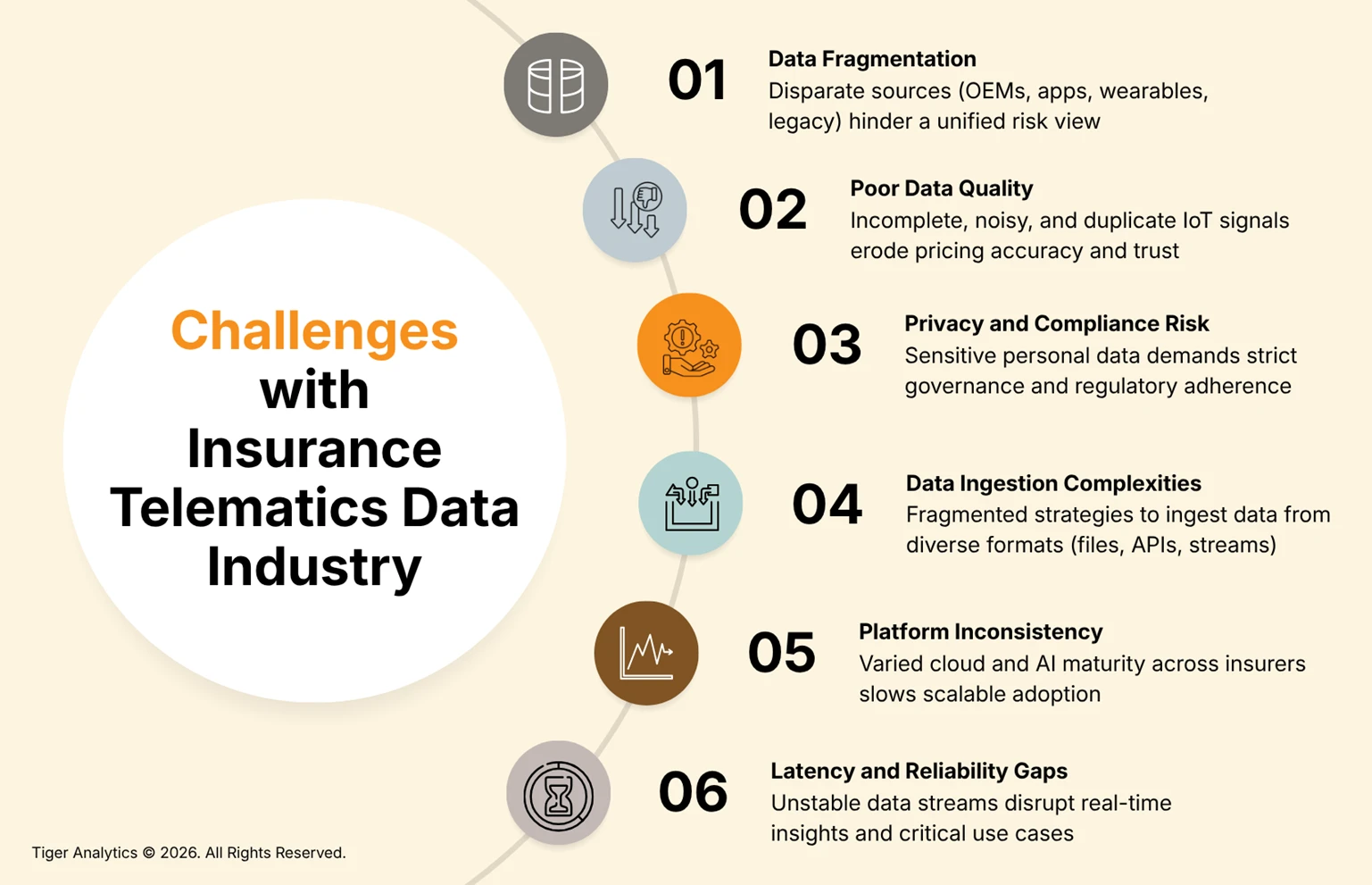
Telematics brings promise, yet many insurers run into the same set of issues once programs expand past early adoption. These challenges mirror what teams describe as programs begin influencing real underwriting and customer-facing journeys:
Data fragmentation: Disparate sources (OEM devices, mobile applications, wearables, and legacy feeds) deliver data in different formats and intervals. Pricing teams end up reconciling multiple versions of trip data instead of working from one trusted dataset.
Poor data quality: Incomplete trips, noisy signals, and duplicate records weaken confidence in downstream usage, eroding pricing accuracy and trust.
Platform inconsistency: Uneven cloud and AI maturity across business units means streaming pipelines, analytics workloads, and machine learning systems run separately, limiting timely decision-making.
Latency and reliability gaps: Unstable data streams and batch-heavy processing disrupt real-time insights. Late feedback weakens customer engagement.
Privacy and compliance risk: Sensitive personal data demands strict governance. Gaps in audit readiness create hesitation even when customer participation is strong.
Building Trust from the Get-Go in Telematics Data Processing
Conventional wisdom in insurance tech suggests that telematics is primarily a volume challenge—that scaling simply requires building wider pipes to accommodate more trip records.
In reality, the bottleneck is a trust problem.
Telematics programs often push trust checks late in the flow. Data lands first, pipelines move it forward, and scrutiny only begins once pricing or scoring teams start using the outputs. By then, gaps create rework and delays. Scaling a flawed, fragmented pipeline does not yield better insights; it merely delivers inaccurate pricing decisions at a higher velocity.
Success depends on shifting governance and validation to the point of entry-ensuring quality the moment data enters the platform so issues remain visible and easier to address.
Tiger Analytics’ Telematics Data Foundation Solution on Databricks
To address these challenges, we partnered with Databricks to develop the Telematics Data Foundation. Our approach moves insurers away from fragile, batch-heavy cycles toward a streaming-led architecture, enforcing rigorous quality checks the moment trip records enter the platform.
Our solution leverages Databricks DLT Auto Loader to establish event-driven data ingestion, embedding DLT Expectations to enforce rigorous quality standards at scale.
In practice, this means incomplete records, duplicates, and noisy IoT signals are quarantined the moment they enter the platform, preventing them from compromising core pricing analytics.
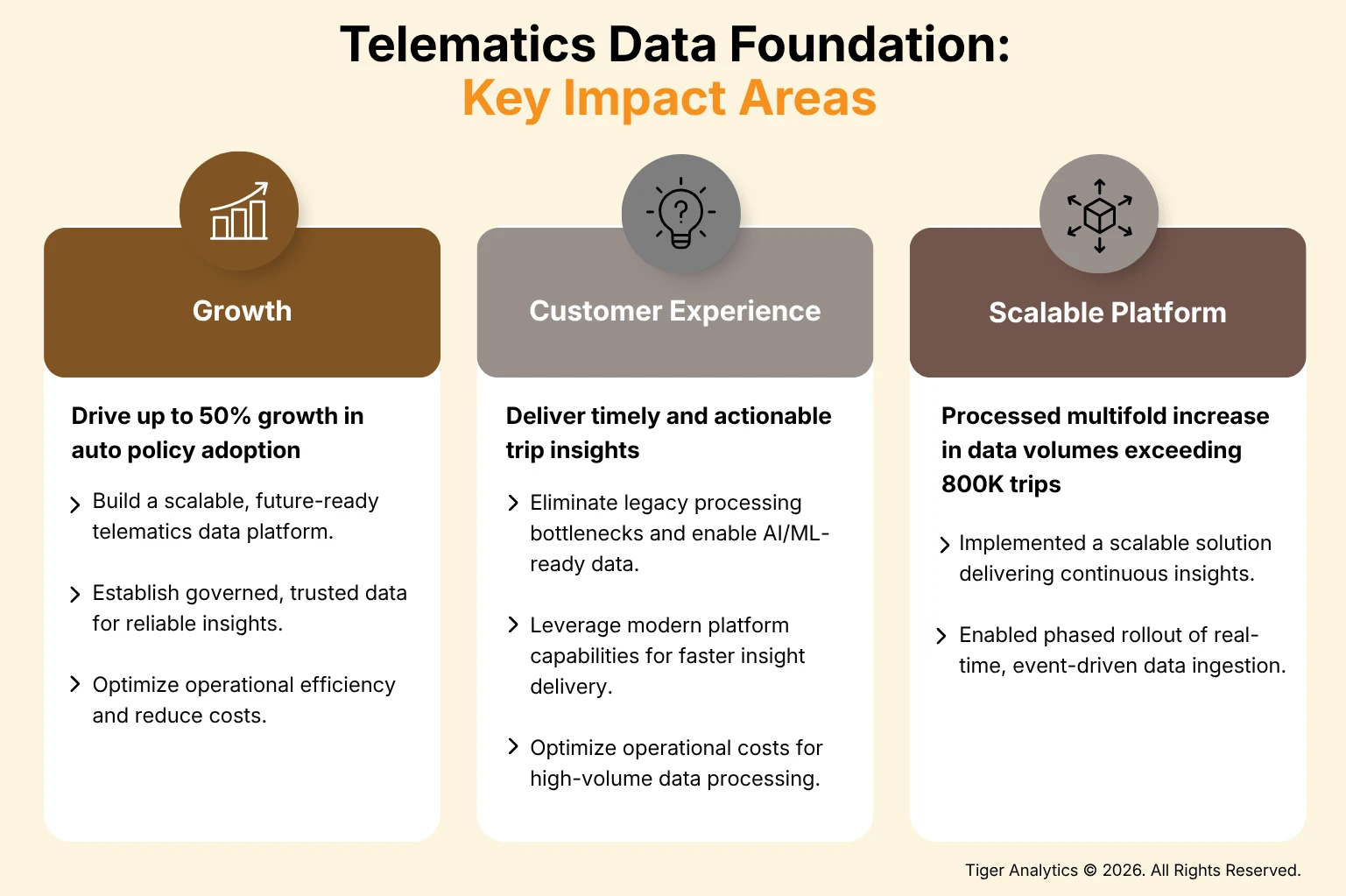
Engineered to absorb sudden demand surges, the platform utilizes Databricks autoscaling to fluidly accommodate 50%+ policy adoption, eliminating the need for manual intervention.
In operational terms, this ensures that during peak events like Friday afternoon rush hour, compute resources adjust in real-time. Throughput remains predictable, while costs stay strictly aligned with actual trip volumes.
Governance is woven into the platform through Unity Catalog, ensuring oversight is native to the data flow rather than an afterthought.
In practice, this allows pricing teams to trace any trip record from ingestion through every transformation. Questions regarding accuracy turn into immediate answers, replacing weeks of manual IT investigation with direct, auditable transparency.
How We Implement a Scalable Telematics Data Platform
Our roadmap for a scalable Telematics Data Platform ensures each stage builds on the last. Skipping steps creates fragile, disconnected systems, while this continuity maintains alignment and reduces rework during scaling.
Phase 1: Assess & Recommend
Success begins by looking beneath the surface of delayed pricing signals. We evaluate architecture, processing frequency, and compute behavior as a unified system. From this diagnosis, batch-led processing gives way to streaming-led movement, ensuring trip data flows continuously instead of waiting in queues. We establish the telematics database and build an end-to-end operational data pipeline, embedding a rigorous data quality framework the moment records enter the platform.
Phase 2: Pilot & Operationalize
With the framework established, the platform is exercised using live data, running streaming pipelines against active trip feeds. Governance is woven in through Unity Catalog, ensuring access rules and lineage are native to the flow, while data reconciliation aligns trip counts across stages to eliminate manual overhead and build confidence in the outputs.
Phase 3: Scale
With operations steady, the platform extends to enable broader usage. Scaled analytics handle higher trip volumes and wider participation without redesigning pipelines. At this stage, telematics supports a unified, cross-line view across auto, home, and commercial assets, maturing into a dependable operating capability rather than a fragile experiment.
Making Telematics a Core Insurance Capability
Usage-based insurance has evolved from a niche experiment into a core strategic priority. Drivers increasingly share their data, pricing teams demand fresher, more precise signals, and leadership expects telematics to drive fundamental underwriting outcomes. A program only scales effectively if data arrives cleanly, flows through continuous streaming architectures, and remains strictly governed from the point of entry to the final insight.
When leadership proposes expanding a usage-based program to new markets or integrating diverse OEM feeds, the critical question is no longer about raw cloud storage capacity.
The real inquiry must be: “If a corrupted wearable sensor floods the system with 10,000 duplicate trip records during the Friday rush hour, at what exact millisecond does our platform identify and quarantine the noise?”