The retail industry is undergoing an accelerated transformation as enterprises reimagine customer engagement and operational excellence. Frontline workers (FLWs), the first point of contact for customers, play a decisive role in shaping brand experience. Yet, as retailers scale operations, the complexity of workflows, fragmented systems, and the demand for real-time responsiveness have created significant efficiency and compliance challenges.
In today’s omnichannel retail environment, customers expect not just availability of products but also speed, accuracy, and a highly informed store associate capable of resolving their queries instantly. This expectation places tremendous pressure on FLWs, who must navigate a maze of operational tasks, ever-evolving product assortments, and device ecosystems all while maintaining a consistently positive customer interaction. Retailers, therefore, are increasingly looking for intelligent tools that augment their workforce without disrupting existing processes.
To address this, Tiger Analytics has developed the AI Agent Companion for Retail Frontline Workers, an intelligent, multimodal, and context-aware assistant that empowers associates with instant access to operational knowledge, product information, and troubleshooting guidance. Built on agentic AI principles, the solution redefines frontline productivity and customer experience through autonomous, sense-and-respond capabilities tailored for retail environments.
This shift toward agent-driven assistance marks a pivotal moment for the retail sector. Unlike traditional digital tools that rely heavily on static interfaces or keyword-based search, agentic systems understand intent, interpret visual cues, and operate across diverse formats: text, voice, and image mirroring the natural working style of associates on the floor. As a result, retailers can finally bridge the gap between digital complexity and real-world execution.
The Business Context: Frontline Complexity Meets Rising Customer Expectations
Retailers such as Walmart, Target, and other global giants are facing an unprecedented dual challenge enhancing customer satisfaction while improving associate efficiency. As frontline teams handle diverse roles like inventory operations, merchandising, and customer service, they often encounter:
- Disjointed systems and siloed data for product, device, or SOP information.
- Time-intensive searches through lengthy documents and outdated manuals.
- Limited real-time visibility into inventory and pricing data.
- Frequent supervisor dependencies for procedural or device-related queries.
This operational fragmentation results in slower response times, reduced productivity, and inconsistent adherence to SOPs, ultimately impacting both employee morale and customer experience.
Moreover, seasonal spikes, high associate turnover, and the rapid introduction of new devices and technologies further complicate store operations. Associates often learn on the job, and without a structured support mechanism, mistakes and delays become inevitable. Supervisors, already stretched thin, cannot intervene in every query making scalable, AI-led support not just beneficial but critical. Additionally, compliance demands around safety, inventory audits, and customer data protection add another layer of complexity that frontline teams must navigate daily.
The Opportunity: Enabling Real-Time Decision Intelligence
The path forward lies in empowering associates with intelligent, contextually adaptive support. Retailers require AI-driven companions that combine natural language understanding, computer vision, and retrieval intelligence to make knowledge and actions instantly available at the point of need.
This goes beyond simple chatbot functionality. Retail operations are dynamic store layouts shift, product packaging changes, and device issues emerge without warning. An effective AI companion must understand these variables and deliver responses that adapt in real time. By integrating multimodal understanding, the system can answer questions such as “What’s wrong with this scanner?” by interpreting an image or “Is this shelf set correctly?” by matching a planogram to live visual input. This elevates frontline decision-making from reactive troubleshooting to proactive, informed action.
By equipping frontline workers with AI-powered digital assistants, retailers can achieve measurable gains in operational efficiency, employee engagement, and customer satisfaction, all while maintaining compliance with organizational standards and processes.
Additionally, real-time decision intelligence dramatically reduces cognitive load for associates. Instead of juggling multiple apps, handheld devices, or paper-based manuals, they gain a unified, conversational interface that guides them step-by-step. This allows retailers to onboard new hires faster, reduce training overhead, and ensure consistent execution across stores key drivers for scaling in a competitive market.
Introducing Tiger Analytics’ AI Agent Companion for Retail Frontline Workers
The AI Agent Companion is a Copilot-powered, multimodal assistant that supports associates through mobile devices, kiosks, voice assistants, and handhelds. It features a “sense and respond” architecture that adapts dynamically to the associate’s task, device, and role, providing instant, contextual support.
This architecture allows the system to intelligently orchestrate workflows, detect when a task is incomplete, and even recommend next-best actions based on the associate’s environment and store-level context. Whether it’s a replenishment task on the shop floor or a troubleshooting request in the back office, the AI Agent Companion adjusts its modality, providing the most efficient path to resolution.
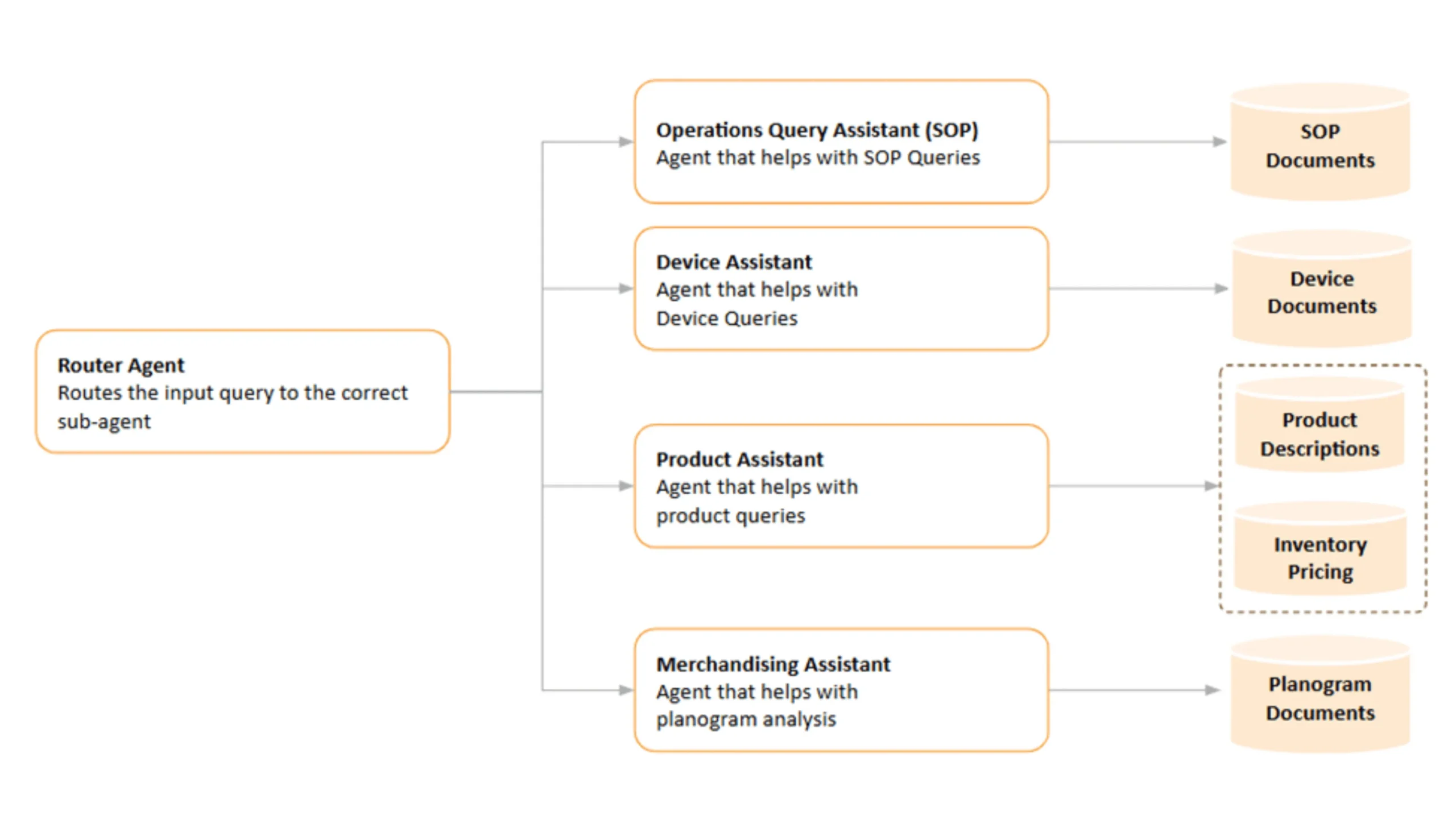
At its core lies a Super Agent orchestrating four specialized sub-agents:
- Operations Query Assistant (SOP Agent): Answers standard operating procedure questions to ensure compliance and minimize escalations.
- Device Assistant: Troubleshoots store devices like scanners and kiosks with step-by-step guidance.
- Product Assistant: Delivers instant answers on availability, pricing, and product details.
- Merchandising Assistant: Validates planograms, identifies shelf deviations, and ensures merchandising accuracy.
This modular framework enables enterprises to scale support across multiple retail functions, driving consistency and efficiency.
The use of sub-agents ensures that expertise is compartmentalized yet interconnected. For instance, if the Product Assistant identifies low stock for an item, the Operations Query Assistant can automatically trigger replenishment guidance. This cross-agent collaboration mirrors the way human teams operate, creating a highly intuitive experience for frontline associates.
Key Features and Differentiators
- Instant Contextual Intelligence: Provides accurate responses using multi-domain knowledge.
- Adaptive Interaction Layer: Tailors interactions by role, device type, and workflow context.
- Multi-Interface Enablement: Works seamlessly across mobile, kiosk, and voice environments.
- Compliance & SOP Assurance: Continuous guidance to ensure process adherence.
- Integrated Frameworks: Pre-built connectors enable smooth integration with retail IT systems.
- Autonomous Operation: AI agents function independently yet collaboratively through shared memory.
- Modular & Scalable Design: Configurable for varying store formats, geographies, and tasks.
- Reduced IT Load: Device troubleshooting agent resolves first-line issues, minimizing support tickets.
These capabilities enable retailers to deploy the solution rapidly without significant infrastructure changes, making it suitable for both large-format hypermarkets and smaller convenience store chains. The AI Agent Companion is also built with enterprise-grade security and governance, ensuring that every interaction remains compliant with data privacy and operational standards. Its ability to learn from store-specific patterns and feedback loops ensures continuous improvement leading to more accurate responses, better task automation, and higher frontline satisfaction.
Flow Architecture
Business Impact
Partnering with a leading US-based technology firm specializing in enterprise retail devices, Tiger Analytics implemented the AI Agent Companion to address complex frontline challenges. The solution delivered measurable impact:
- Reduced training time through conversational onboarding and guided task assistance.
- Improved associate productivity by minimizing search time and workflow disruptions.
- Enhanced customer satisfaction with faster, accurate responses during interactions.
- Streamlined knowledge management through unified access to SOPs, product data, and troubleshooting guides.
Sample interactions demonstrate its efficiency:
- “What is our return policy?” → Immediate retrieval of accurate policy details by category.
- “How do I reset this device?” → Guided troubleshooting in real time.
- “Is product X from brand Y in stock?” → Instant availability and location insights.
- “Show planogram details for item Z.” → Quick validation with visual or textual context.
In addition to these examples, stores observed a significant drop in operational bottlenecks such as stalled checkouts due to device malfunctions or incomplete merchandising tasks. Supervisors reported fewer escalations, enabling them to focus on value-added responsibilities like team coaching or customer engagement. The AI Agent Companion also contributed to greater consistency across shifts, an often-overlooked challenge in retail, where night and weekend teams may lack the same levels of supervision or expertise.
The Future of Frontline Enablement
The AI Agent Companion represents a significant step toward agentic, context-aware enterprise AI in retail. As multimodal interactions become standard, retailers can harness intelligent agents not just to assist but to autonomously act within defined parameters enhancing decision-making, compliance, and customer trust.
With scalable architecture, seamless integrations, and domain-trained intelligence, Tiger Analytics’ AI Agent Companion equips enterprises to move from reactive task execution to proactive, insight-driven frontline empowerment.
Looking ahead, the evolution of retail AI will extend toward predictive task management, autonomous stock monitoring, and advanced sensor integrations. AI agents will increasingly collaborate with IoT-enabled devices, robotics, and digital store systems, creating a truly interconnected operational ecosystem. This will allow associates to focus on high-touch interactions that build loyalty and differentiate the brand while AI handles the routine, complex, or time-consuming tasks. Ultimately, the future of frontline enablement lies in a symbiotic model where human empathy meets machine intelligence to deliver exceptional retail experiences.