Every enterprise leader is being asked the same question: are you ready for AI? The honest answer, for most organizations, is: ready for some of it. And as agentic AI moves from research preview to production deployment, the bar for what “ready” means is rising.
AI readiness is the structural capacity of an enterprise to adopt artificial intelligence in a way that is reliable, governed, and sustainable across production environments. It is not a technology purchase or a pilot milestone. It is an operational state built across data, infrastructure, governance, and talent. Agentic AI raises the stakes further: autonomous agents that plan, decide, and act across enterprise systems require a more rigorous foundation than models that respond to a single query. The gap between where most enterprises currently sit and what production-grade agentic AI actually requires is larger than it looks from the outside.
The Real Blocker Is Rarely the Model
When enterprise AI deployments underperform, leadership looks at the model first. The model is rarely the problem. The environment it operates in is. Enterprise data platforms were built for human consumption: dashboards, batch reports, analyst workflows. AI agents need machine-readable schemas, unified entity identities, near-real-time data access, and trust signals embedded at the data layer. Agentic systems compound these needs: an agent orchestrating actions across multiple tools and datasets is only as reliable as the weakest data layer it touches.
The underlying issue is almost always not the model. It is whether the data foundation is worthy of the AI built on top of it, and that becomes non-negotiable when the AI in question is acting autonomously on behalf of the business.
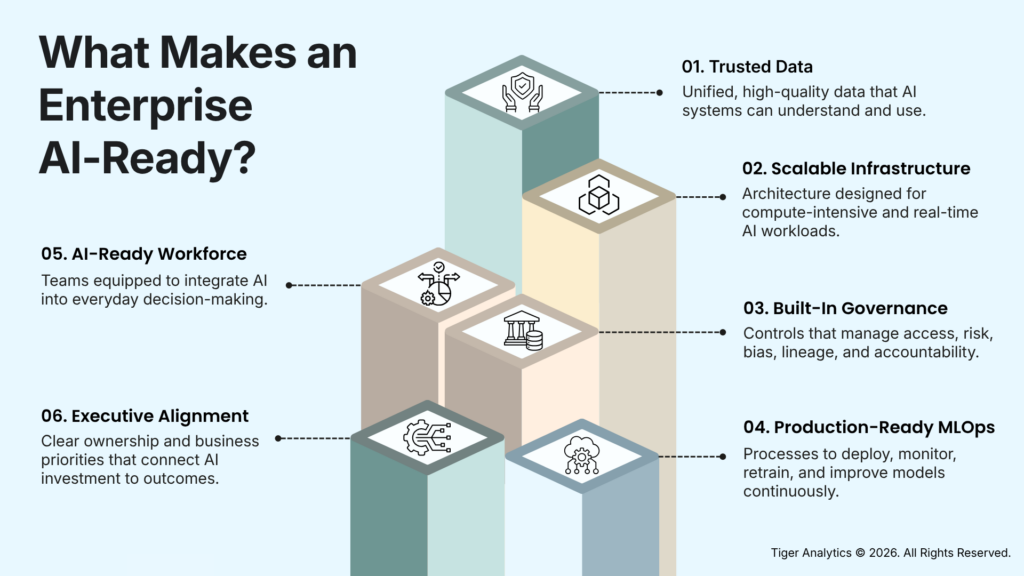
Five Dimensions That Determine AI Readiness
AI readiness spans five interconnected areas. For organizations building toward agentic AI, these are not checkboxes; they are the operating conditions that determine whether autonomous systems can be trusted in production.
- Data Foundation
The most common and consequential gap. AI-ready data requires semantic clarity, unified identity resolution, near-real-time pipeline access, and quality trust signals that travel with the data. For agentic AI, this is especially critical: an agent acting across systems has no human in the loop to catch inconsistencies. A global CPG leader demonstrated this when modernizing its data ecosystem on Azure and Databricks, transitioning to a layered, AI-ready data model that established a single source of truth across the enterprise. - Infrastructure and Architecture
The technology stack must support the compute, latency, and integration requirements of production AI. Agentic systems introduce unique requirements: persistent memory, multi-step reasoning under latency constraints, tool-use APIs, and safe orchestration across internal and external services. Victoria’s Secret modernized its analytics infrastructure to Azure and Snowflake, achieving a 34% reduction in compute costs and a 100% workload migration success rate over ten months. - Governance and Risk Controls
Governance is not a constraint on AI deployment. It is what makes confident scaling possible. For agentic AI, it is non-negotiable: when a system can autonomously query databases, call APIs, and trigger downstream actions, the organization must have clear answers to who authorized the action, what guardrails exist, and how errors are detected and corrected. This means access controls for non-human actors, model registries, audit trails, and agent-specific controls including scope boundaries, escalation rules, and human-in-the-loop checkpoints for high-stakes decisions. Inspiro’s enterprise data platform build on Microsoft Fabric illustrates this: role-based access control, metadata-driven lineage, and audit-ready governance reduced reporting turnaround from one to two days to approximately one hour, and laid the groundwork for AI systems that operate with accountability at scale. - MLOps Maturity
MLOps is a categorically different discipline from standard software delivery: models degrade as real-world data drifts from training distributions and need performance monitoring that goes well beyond uptime. Agentic systems add complexity through multi-model pipelines, tool-calling chains, and feedback loops where errors in one step propagate through subsequent actions. A leading credit card issuer’s fraud detection modernization demonstrates the stakes: stable, validated models with full MRM documentation and pre-production monitoring cut fraud losses by $5M. - Organizational Alignment
Technology capability without organizational readiness consistently underperforms. Enterprises that treat AI fluency as a workforce-wide objective scale faster and with fewer failures. Agentic AI raises this bar further: employees need to understand how to work alongside autonomous systems, when to intervene, and how to interpret agent-generated outputs. Executive alignment matters equally: AI initiatives that operate below C-suite ownership rarely achieve the cross-functional integration production deployment requires. Mead Johnson’s SAP data modernization is a case in point: as Tiger Analytics moved from solution provider to integration partner, shaping governance models and simplifying access for decision-makers, it set the foundation for AI-powered decisioning across business units.
Where to Start: A Structured Assessment
A readiness assessment maps current-state maturity across the five dimensions, identifies the gaps most likely to constrain near-term deployment, and produces a prioritized roadmap sequenced by business impact. For organizations with agentic AI on the horizon, the assessment must also evaluate whether the governance, infrastructure, and data environment can support systems that act, not just advise.
Most organizations are partially ready: strong in some dimensions, underdeveloped in others. Closing the gap does not require a full-scale transformation. It requires identifying which specific constraints are blocking production deployment today and addressing those directly. The enterprises that consistently convert AI investment into outcomes are not the ones with the most advanced models. They are the ones with the foundation that lets capable models operate reliably at scale.
Tiger Analytics works with enterprise teams to assess AI readiness, close capability gaps, and build the operational infrastructure for production deployment, including agentic AI. Contact us to speak with our specialists.
Download our whitepaper: Bridging the AI Readiness Gap
Take the assessment: AI Readiness Check
Frequently Asked Questions
- What is AI readiness, and why does it matter for enterprises?
AI readiness is the structural capacity to deploy artificial intelligence reliably at scale. The most common reason enterprise AI fails is not model performance. It is the absence of data foundations, governance controls, infrastructure, and organizational alignment required for production deployment. As enterprises move toward agentic AI, readiness becomes more critical: autonomous systems require a more rigorous operational environment than models that simply respond to queries. - How is AI readiness different from AI maturity?
AI maturity refers to the sophistication of models and techniques an organization uses. AI readiness is broader: it includes data infrastructure quality, governance frameworks, MLOps processes, and workforce alignment alongside technical capability. An enterprise can have highly mature data science talent and still have low AI readiness if the operational infrastructure to deploy that talent reliably does not exist. - What does AI readiness mean specifically for agentic AI?
Agentic AI readiness requires everything standard AI readiness requires, plus additional dimensions: governance controls designed for autonomous action, infrastructure that supports persistent agent memory and tool orchestration, MLOps processes that handle multi-model pipelines, and an organizational culture that understands when and how to trust, oversee, and correct autonomous systems. - What is the biggest gap that prevents enterprises from becoming AI-ready?
The data foundation. Most enterprise data platforms were built for human analysts: dashboards, reports, batch-oriented workflows. AI agents require machine-readable semantics, unified entity identities, near-real-time access, and embedded trust signals. For agentic systems, these requirements are amplified: an agent acting across multiple data sources has no human review step to catch errors before they propagate. - Where should enterprise leaders begin an AI readiness initiative?
Begin with a structured assessment that establishes a baseline across the five dimensions: data foundation, infrastructure, governance, MLOps maturity, and organizational alignment. For organizations with agentic AI on the roadmap, the assessment should evaluate whether governance structures can handle autonomous action and whether the data and infrastructure environment can support multi-step agent workflows. The assessment identifies which gaps are blocking deployment and produces a prioritized roadmap based on business impact. - What is the difference between Generative AI readiness and Agentic AI readiness?
Generative AI readiness focuses on data cleanliness for generating accurate text or insights. Agentic AI readiness requires autonomous orchestration capabilities, machine-readable semantic schemas, non-human actor RBAC (role-based access controls), and deterministic governance guardrails for execution. - Why do enterprise Agentic AI deployments fail?
Failures usually stem from an unprepared data layer built for human consumption (dashboards/reports) rather than AI reasoning (APIs, real-time data, and trust signals), as well as a lack of clear scope boundaries for autonomous decisions.