


mobile-banner

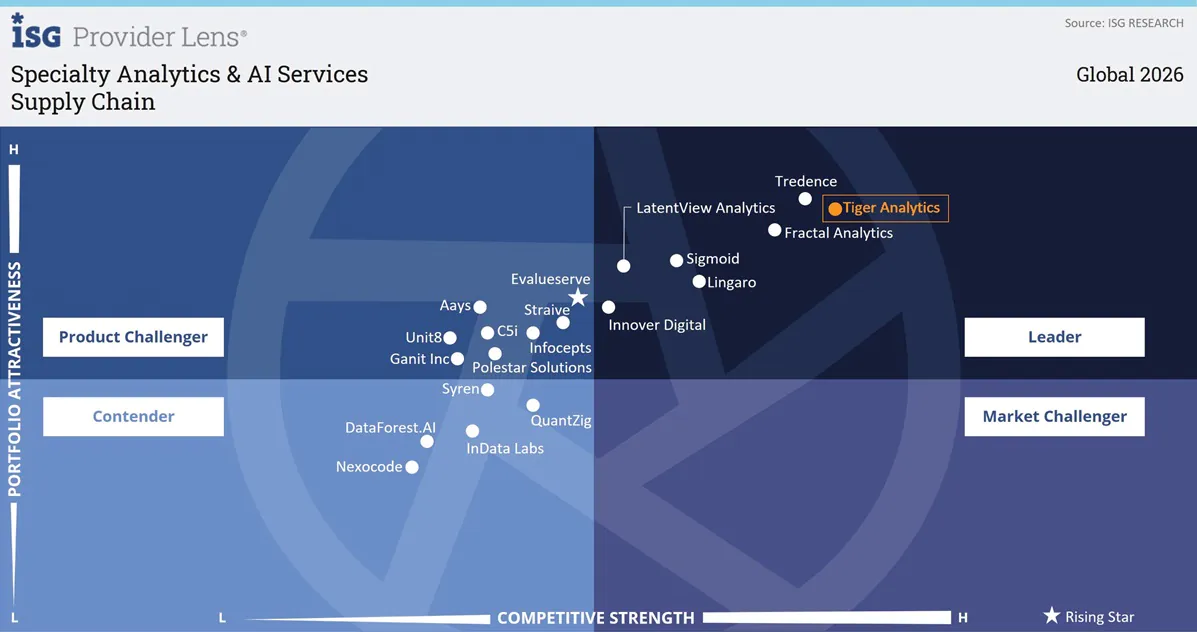
Recognised Leader in Supply Chain –
Specialty Analytics and AI Services
by ISG

For empowering next-gen supply chains through predictive intelligence, autonomous operations, and continuous optimization.

Supply Chain Specialty Analytics AI Services

Why Tiger Analytics is a Leader?

  • AI-driven insights and decision intelligence:
    AI-powered insights that turn real-time data into contextual, actionable decisions.
  • Autonomous and agentic supply chain execution:
    Agentic AI that enables adaptive, resilient, and continuously optimized supply chain execution.
  • Unified data platform:
    A scalable, AI-ready data platform delivering governed, connected, and business-ready intelligence.

From the Analyst Desk

“Tiger Analytics differentiates with its unified SCAI platform that combines data foundation, AI-driven insights and agentic execution to enable end-to-end, real-time supply chain decision intelligence and scalable transformation.”

Manav Deep Sachdeva

Manav Deep Sachdeva

Senior Manager and Principal Analyst, ISG

Discover the ISG Verdict

See why Tiger Analytics is a #1 Leader, straight from the analysts.

Explore our Databricks Partnership

From insight to autonomous action, see how we redefine supply chain performance.

Supply Chain Success Stories

Case Study

How Agentic AI enabled a Global F&B Leader to Enhance Warehouse Operations

Read More

Case Study

How Data-Driven Supply Chain Innovation Enabled a Global Sportswear Leader to Boost Full Price Realization and Operational Efficiency

Read More

Case Study

How GenAI Enabled a Major Retailer to Achieve Data-Driven Supply Chain Transformation

Read More
FAQs
Q1. What does being ranked #1 in ISG's Supply Chain Specialty Analytics and AI Services report two years in a row actually mean for customers & prospects?

This ranking reflects Tiger’s leadership in AI- powered Supply Chain analytics. Sustaining the top position in a year that ISG described as highly competitive, against strong challenges from peers, signals that Tiger’s solution portfolio, delivery excellence, and value impact are structurally strong while being agile to client needs.


Q2. What does Tiger Analytics add when a company already has a Supply Chain platform and a System Integrator in place?'?

Today’s supply chain problems need NextGen solutions that address two priorities simultaneously – preserving and evolving what already works, while transforming and modernizing for what comes next. Tiger’s unique approach blends both, overcoming cross-functional challenges in existing investments alongside building new AI-powered end-to-end capabilities for a resilient supply chain.

Q3. How does Tiger Analytics handle silos (Data / Process / People) in the organization?

Silos in data, processes, and people stem from fragmented tech stacks, disconnected systems, and functions operating at different maturity levels. Tiger addresses this through a layered approach, unifying data via custom enterprise data foundations and supply chain data models, then building interoperable data products that create a shared intelligence layer across functions. The result is a coherent strategy where every building block supports the next.

Q4. Why do most supply chain AI pilots fail to reach production, and how does Tiger approach this differently?

Most pilot-to-production failures are design problems, not talent problems. Tiger embeds productionization from the start, with a Supply Chain Intelligent Data Platform that handles governance, data quality, and domain-context-aware ingestion, ensuring models have the reliable foundation they need to operate at enterprise scale. Intelligent Supply Chain Agents then extend this with structured autonomous execution across the value chain, making production-scale AI the baseline.

Q5. Supply chain and Finance teams rarely agree on forecasts and assumptions. How does Tiger solve for cross-functional alignment?

While analytical capabilities in supply chains are advancing rapidly, decision-making maturity is not evolving at the same pace. Research indicates that 75% of analytics work happens outside the model: defining the right business question, stress-testing assumptions, translating outputs into operational reality, and aligning cross-functional teams before recommendations reach leadership for change management. Tiger addresses this gap by embedding decision discipline throughout every engagement, ensuring analytics translate into business decisions and measurable outcomes, rather than simply producing reports.

Q6. CXO: We're tired of supply chain projects defined by technology and process steps. Can Tiger start from a business outcome and work backwards?

Tiger’s Mission AI approach starts with a clearly defined business outcome, aka mission, and works backwards. Each mission is decomposed into focused sub-missions, assigned to cross-functional agent clusters that work concurrently across the value chain. At key steps, humans remain in the loop to validate critical choices and capture the rationale, turning a business goal into a coordinated, outcome-driven plan rather than a process map.

Copyright © 2026 Tiger Analytics | All Rights Reserved